



When Your Passion Exceeds Your Capacity — Part 1
The Science Behind Why High-Achieving Women Burn Out Hormonally
April is Stress Awareness Month. The most powerful thing you can do for your hormones this month is not a new supplement. It is this.
Right now, my husband Scott and I are deep in a home remodel — tile selections, contractor decisions, furnishing choices. Beautiful and intentional. Also a significant load on top of an already full life.
My ambition has not changed. My capacity has a different answer right now.
Sound familiar? Then this post is for you.

You cannot out-hormone a stressed nervous system. And you cannot out-perform your capacity without your biology eventually presenting the bill.
Capability vs. Capacity — The Distinction That Changes Everything
Tamu Thomas, in Women Who Work Too Much, names something most high-achieving women have never had language for (1).
Capability = what you are able to do. Capacity = what your body can actually sustain right now.
High-achieving women almost universally push past their capacity — because their capability says they can and their culture says they should.
Capability is what you CAN do. Capacity is what your body can sustain. They are not the same thing. And confusing them is costing you your health.
Thomas also introduces the concept of
Life ethic vs. work ethic.
We celebrate the work ethic — the output, the grinding. A life ethic asks something deeper: a commitment to how we actually live, not just what we produce. For perimenopausal women, this is not philosophical. It is hormonal.
The Pregnenolone Steal — What Chronic Stress Does to Your Hormones
Your body manages stress through the HPA axis — the hypothalamic-pituitary-adrenal axis (your body’s central stress command center) (2). In short bursts, cortisol is healthy and adaptive. But under chronic activation, your body diverts pregnenolone — the mother hormone (the master raw material used to make ALL steroid hormones including progesterone, estrogen, and DHEA) — away from progesterone and toward making more cortisol (3).
Progesterone drops. And in perimenopause — where progesterone is already declining — this steal accelerates the decline dramatically.
Your stress response is literally stealing from your calm. Every time your nervous system fires in survival mode, it borrows from your progesterone to pay the cortisol bill.
The Downstream Domino: Relative Estrogen Dominance
When progesterone drops, it creates relative estrogen dominance — estrogen becomes dominant relative to falling progesterone, even if estrogen itself is not elevated. The symptoms are ones many perimenopausal women know well:
- Weight gain around the hips and belly
- Breast tenderness, bloating, water retention
- Mood swings, anxiety, brain fog
- Heavy or irregular periods and disrupted sleep
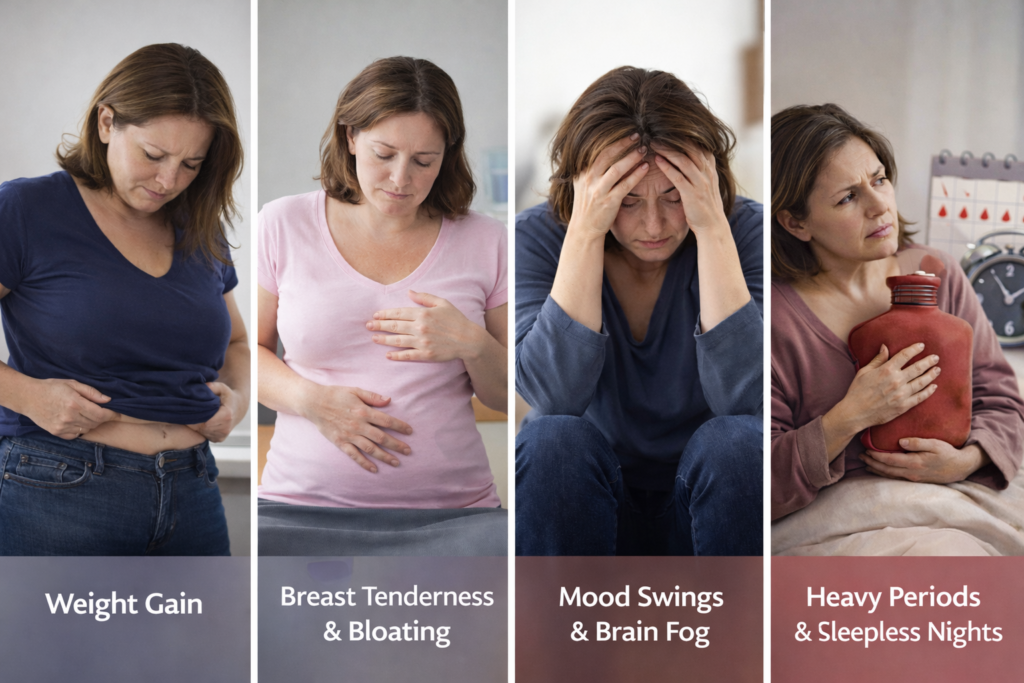
Sound familiar? Stress doesn’t just exhaust you — it creates the hormonal conditions that make everything else harder to fix.
→ Not sure if estrogen dominance is part of your picture? Take the FREE Hormone Quiz to find out.
Allostatic Load — The Stress Bank Account
McEwen and Stellar coined the term allostatic load to describe the cumulative wear and tear of chronic stress over time (4) — think of it as a stress bank account. Every demand makes a withdrawal. Every genuine recovery makes a deposit. When withdrawals consistently exceed deposits, your hormones start paying the overdraft fees.
Research shows women carry measurably higher allostatic load than men by midlife (5) — and even good stress makes withdrawals. My remodel is exciting and chosen. It is still drawing from the same account.
Your nervous system does not distinguish between stress that feels good and stress that feels bad. It only measures load. And load accumulates.
The Lab Truth — Your Body Doesn’t Lie
A 34-year-old mother of seven sat across from me. When I asked how stressed she was, her answer was immediate:
“I’m NOT stressed.”
Her salivary cortisol panel was significantly dysregulated. She genuinely believed she was fine.
Many high-achieving women have normalized their stress load so completely they no longer recognize it. Adaptation is not the same as health (6).
You can believe you are fine. Your cortisol pattern may disagree. The body keeps score even when we stop counting.
You Cannot Out-Hormone a Stressed Nervous System
Women who add hormonal support without addressing nervous system dysregulation experience partial results at best (7). The hormones arrive — but they are entering an environment still in survival mode. The body cannot fully utilize what it is being given.
Nervous system regulation is not an add-on to hormone health. It is the foundation. And recovery looks like strategic subtraction:
- Fewer appointments — capacity says not right now
- Boundaries from biological wisdom, not guilt
- Rest as non-negotiable infrastructure, not reward

What you are NOT doing is as hormonally important as what you are doing. Subtraction is medicine too.
My Transparency
I am a woman with enormous capability. And right now, in the middle of a home remodel, I have had to honestly ask:
What is my actual capacity right now? Not my capability. My capacity.
My schedule is lighter than it has been in years. Fewer clients. Protected mornings. Real sleep. Not because I have given up — because I know what happens to my progesterone when I do not.
Can you relate?
My ambition has not changed. My capacity has a different answer right now. And I am choosing to honor that — because my hormones are counting on me to.
You model what you teach. Or eventually — your body models it for you.
Next Week — Part 2
Now that you understand the WHY, next week we cover the HOW — two specific practices most high-achieving women have never tried, and what my HRV data revealed about 35 years without TV.
Part 2: The Two Practices Every High-Achieving Woman Needs — April 22.
🎁 FREE GIFT: My FREE Nervous System Reset Video — a somatic (body-based) practice for shifting out of survival mode. →
Ready for personalized support? Book your FREE 20-minute Vitality Assessment Call at ConsultLori.com.
Creating the Vitality You Crave,
Lori Finlay, NP, CNS
Award-Winning Author, Create the Vitality You Crave
References
APA 7th edition format. Citations in order of appearance.
1. Thomas, T. (2023). Women who work too much: Break free from toxic productivity and find your joy. Hay House UK.
2. Guilliams, T. G., & Edwards, L. (2010). Chronic stress and the HPA axis: Clinical assessment and therapeutic considerations. The Standard, 9(2), 1–12.
3. Ranabir, S., & Reetu, K. (2011). Stress and hormones. Indian Journal of Endocrinology and Metabolism, 15(1), 18–22.
4. McEwen, B. S., & Stellar, E. (1993). Stress and the individual: Mechanisms leading to disease. Archives of Internal Medicine, 153(18), 2093–2101.
5. Dowd, J. B., Simanek, A. M., & Aiello, A. E. (2009). Socio-economic status, cortisol and allostatic load: A review of the literature. International Journal of Epidemiology, 38(5), 1297–1309.
6. Hellhammer, D. H., Wüst, S., & Kudielka, B. M. (2009). Salivary cortisol as a biomarker in stress research. Psychoneuroendocrinology, 34(2), 163–171.
7. Stephens, M. A., & Wand, G. (2012). Stress and the HPA axis: Role of glucocorticoids in alcohol dependence. Alcohol Research: Current Reviews, 34(4), 468–483.


