


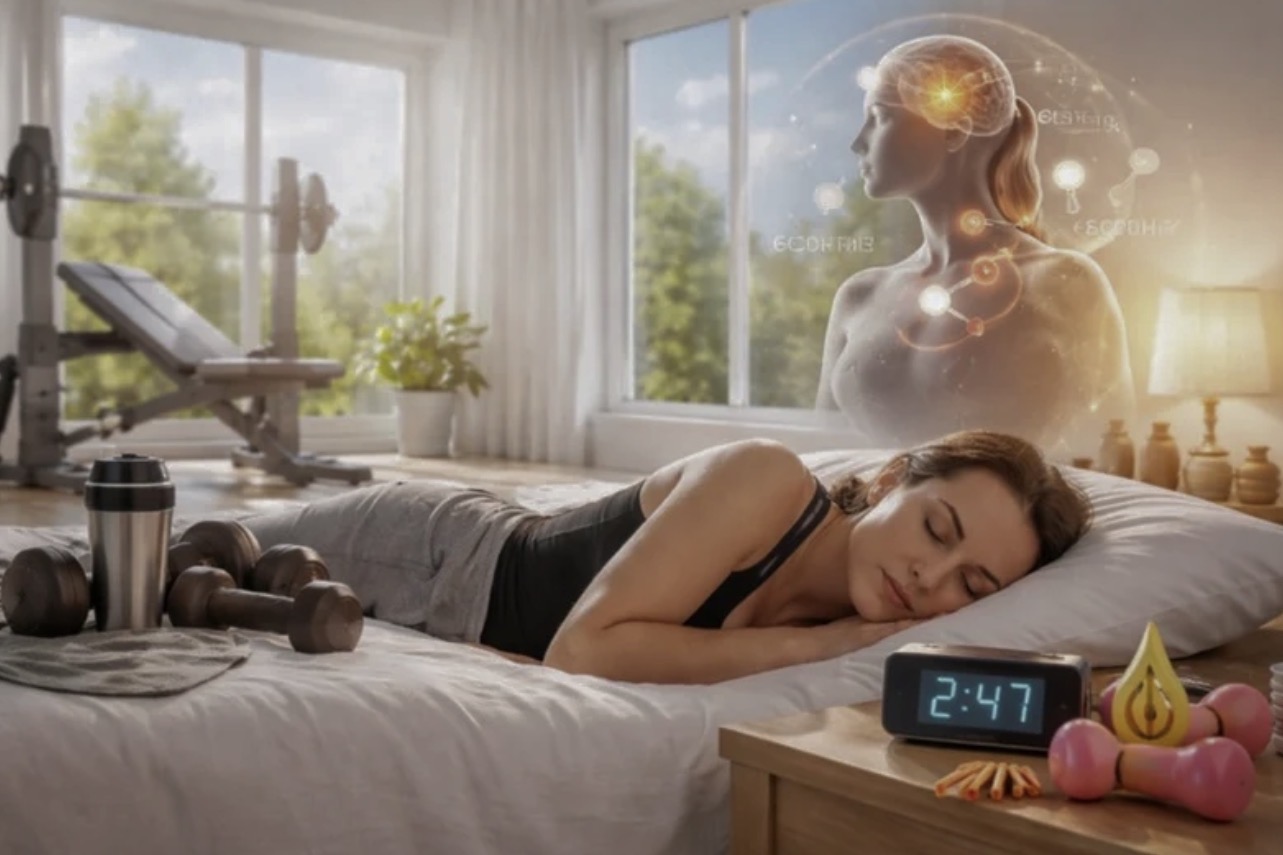
Late Nights Are Stealing Your Hormones — and Your Muscle
What Your Circadian Rhythm Is Trying to Tell You
Let me ask you something honest.
You eat your protein. You show up to the gym. You take your supplements. You are doing everything right.
So why does nothing feel like it is working?
I hear this from women every single week. And most of the time, the missing piece is not what they are eating or how hard they are training.
“Sleep is not laziness. Sleep is when your body does the actual WORK.”
It is when they are sleeping — and whether their body’s internal clock is in sync.
Your circadian rhythm — your body’s built-in 24-hour schedule — controls nearly every hormone you have. When it gets disrupted, the whole system pays the price.
This is especially true for women in perimenopause and beyond. Because when our hormones are already shifting, a disrupted sleep clock can quietly make everything worse.
What Is Your Circadian Rhythm, Really?
Think of your circadian rhythm as your body’s internal conductor. It tells every organ, gland, and cell when to be active and when to rest — including when to release hormones. It runs on light, meal timing, and sleep patterns. When those cues are consistent, your hormones run on schedule. When they get disrupted — late nights, screens after dark, irregular bedtimes — your entire hormonal symphony goes off key (1).
Cortisol: Your Morning Alarm Hormone
In a healthy rhythm, cortisol peaks within 30–45 minutes of waking — called the Cortisol Awakening Response — and reaches its lowest point at night so your body can rest and repair (2).
When your rhythm is disrupted, cortisol stays elevated at night. And that is when it becomes destructive.
Chronically high nighttime cortisol triggers what is called pregnenolone steal — your body diverts the raw materials meant for progesterone production and uses them to make more cortisol instead.
Progesterone drops. Estrogen dominance develops. And suddenly you are dealing with irregular cycles, worsening PMS, anxiety, poor sleep, and weight gain — without understanding why.
Studies on women with disrupted circadian rhythms — especially night shift workers — show higher rates of estrogen-dominant conditions and elevated breast cancer risk (3).
The Two Hormones Nobody Tells You About
Most women know leptin and ghrelin as hunger hormones. But their role goes much deeper — they directly influence whether your muscles build, repair, and grow.

Leptin: Your Muscle’s Best Friend
When leptin works properly, it activates muscle protein synthesis and supports IGF-1 — one of the most powerful muscle-building signals in your body (4). Chronic poor sleep causes leptin to drop and eventually leads to leptin resistance. Your muscles stop hearing its signal entirely — similar to insulin resistance. This is directly linked to sarcopenia: the progressive muscle loss that accelerates after menopause (11).
Ghrelin: The Hunger Hormone That Steals Your Muscle
Just two nights of poor sleep can spike ghrelin by up to 28% (6). When chronically elevated, ghrelin increases muscle inflammation and accelerates muscle wasting — especially dangerous when estrogen, which normally protects muscle, is already declining (5).
Women sleeping under six hours show measurably less muscle mass and grip strength than those sleeping seven to nine hours (10).
What Happens to Your Muscles While You Sleep Poorly
Between 70–80% of your daily growth hormone is released during deep sleep — in the first few hours of the night. This is your body’s overnight construction crew. It repairs muscle from your workouts and builds new tissue (8).
No deep sleep = no construction crew = muscle breaks down faster than it can rebuild.
Disrupted sleep also keeps cortisol elevated at night — and cortisol is catabolic. It actively breaks muscle tissue down. Studies show that people with poor sleep have significantly higher muscle protein breakdown rates even when eating adequate protein (7). You can eat all the protein you want — but if cortisol is high at night, your body is in breakdown mode, not repair mode.
Why This Is Especially Critical for Women as We Age
Women can lose up to 30% of their muscle mass between ages 50 and 70 — and poor sleep is one of the biggest accelerators (9). Sarcopenia is directly linked to falls, fractures, type 2 diabetes, and early mortality.
This is not about vanity. Strong muscles mean stronger bones, better balance, better blood sugar control, and a longer, more independent life.
My Transparency — I Have Lived This
I want to be real with you.
There was a season in my life where I was pushing hard — early mornings, late nights, screens in bed, irregular sleep. I thought I was being productive. I thought rest was something I could earn later.
My hormones had a different opinion.
When I finally prioritized my circadian rhythm — consistent bedtime, morning light, screens off after 8 — my sleep deepened, my progesterone stabilized, and my body started responding again.
Not overnight. But measurably.
Sleep is not a luxury. It is physiology. And your body is keeping score.
5 Things You Can Do Starting Tonight

1. Sunlight before Screen light.
Sunlight is the most powerful reset for your circadian clock. Step outside — no sunglasses — for 10–20 minutes. This triggers the correct cortisol peak and sets your hormone schedule for the entire day.
2. Create a Digital Sunset.
Blue light from screens suppresses melatonin and keeps cortisol elevated. Dim the lights, use blue-light glasses, and wind down gradually.
3. Eat your largest meals — and your protein — earlier in the day.
Muscle protein synthesis is most efficient in the morning and afternoon. Late-night eating disrupts leptin signaling and insulin sensitivity.
4. Keep a consistent bedtime — even on weekends.
Your hormone clock runs on schedule. Irregular sleep patterns mean your body never knows what to prepare for.
5. Protect your deep sleep.
Cool room (65–68°F), no screens 60 minutes before bed, and 7–9 hours are non-negotiable for muscle maintenance and hormone balance (8).
FREE GIFT: Grab my FREE Audio Relaxation to help you wind down and signal your nervous system that it is safe to rest. → Click HERE
The Bottom Line
Your circadian rhythm is the master conductor of your entire hormonal symphony. When it is off, every system pays the price — especially your muscles, your progesterone, and your sleep.
For women in perimenopause and beyond, protecting your sleep schedule is one of the most powerful, underutilized tools available. It costs nothing. It requires no prescription.
Sleep is medicine. Treat it that way.
Ready to take the next step? Book your FREE 20-minute consultation at ConsultLori.com.
Creating the Vitality You Crave,
Lori Finlay, MSN, NP
Award-Winning Author, Create the Vitality You Crave

References
1. Reppert, S. M., & Weaver, D. R. (2002). Coordination of circadian timing in mammals. Nature, 418(6901), 935–941. https://doi.org/10.1038/nature00965
2. Clow, A., Thorn, L., Evans, P., & Hucklebridge, F. (2004). The awakening cortisol response: Methodological issues and significance. Stress, 7(1), 29–37. https://doi.org/10.1080/10253890410001667205
3. Bhatti, P., Mirick, D. K., & Davis, S. (2009). Circadian gene expression and breast cancer risk. Cancer Epidemiology, Biomarkers & Prevention, 18(5), 1340–1347. https://doi.org/10.1158/1055-9965.EPI-08-1091
4. Wolsk, E., Mygind, H., Grondahl, T. S., Pedersen, B. K., & van Hall, G. (2012). Leptin augments the exercise-induced increase in muscle glucose uptake. The Journal of Physiology, 590(21), 5361–5371. https://doi.org/10.1113/jphysiol.2012.233890
5. Nass, R., Pezzoli, S. S., Oliveri, M. C., Patrie, J. T., Harrell, F. E., Clasey, J. L., Heymsfield, S. B., Bach, M. A., Vance, M. L., & Thorner, M. O. (2008). Effects of an oral ghrelin mimetic on body composition and clinical outcomes in healthy older adults. Annals of Internal Medicine, 149(9), 601–611. https://doi.org/10.7326/0003-4819-149-9-200811040-00003
6. Spiegel, K., Tasali, E., Penev, P., & Van Cauter, E. (2004). Brief communication: Sleep curtailment in healthy young men is associated with decreased leptin levels, elevated ghrelin levels, and increased hunger and appetite. Annals of Internal Medicine, 141(11), 846–850. https://doi.org/10.7326/0003-4819-141-11-200412070-00008
7. Dattilo, M., Antunes, H. K. M., Medeiros, A., Monico-Neto, M., Souza, H. S., Lee, K. S., Tufik, S., & de Mello, M. T. (2011). Sleep and muscle recovery: Endocrinological and molecular basis for a new and promising hypothesis. Medical Hypotheses, 77(2), 220–222. https://doi.org/10.1016/j.mehy.2011.04.017
8. Van Cauter, E., Leproult, R., & Plat, L. (2000). Age-related changes in slow wave sleep and REM sleep and relationship with growth hormone and cortisol levels in healthy men. JAMA, 284(7), 861–868. https://doi.org/10.1001/jama.284.7.861
9. Maltais, M. L., Desroches, J., & Dionne, I. J. (2009). Changes in muscle mass and strength after menopause. Journal of Musculoskeletal and Neuronal Interactions, 9(4), 186–197.
10. Buchmann, N., Spira, D., Norman, K., Demuth, I., Eckardt, R., & Steinhagen-Thiessen, E. (2016). Sleep, muscle mass and muscle function in older people. Somnologie, 20(4), 251–258. https://doi.org/10.1007/s11818-016-0093-6
11. Harber, M. P., Konopka, A. R., Jemiolo, B., Trappe, S. W., Trappe, T. A., & Reidy, P. T. (2010). Muscle protein synthesis and gene expression during recovery from aerobic exercise in the fasted and fed states. The Journal of Applied Physiology, 109(1), 135–140. https://doi.org/10.1152/japplphysiol.01108.2009


