



Your Yard, Your Hormones, and the Toxins Nobody Warned You About
What Pesticides, Herbicides, and Everyday Plastics Are Doing to Your Estrogen
Most women think carefully about what goes into their bodies. But very few think about what is happening in the backyard.
The lawn service. The weed killer. The garden hose in the sun. The synthetic turf at the park where kids play barefoot all summer.
These are documented sources of hormone-disrupting chemicals — and for women in perimenopause, they add to a total burden that is already under pressure.

You cannot control every exposure. But you can reduce your total burden with a few intentional swaps. And your hormones will feel the difference.
Earlier this month we explored how the estrobolome — your gut’s estrogen-regulating bacteria — is disrupted by environmental chemicals. If you missed that post, read it here first — it lays the foundation for everything we cover today.(1)
Why Small Exposures Add Up
Your body stores environmental chemicals in fat cells, breast tissue, and organs — what researchers call your total body burden (the cumulative load of toxins your body is carrying at any given time) (2). Research shows these compounds can be MORE disruptive at lower, repeated doses — because at low concentrations they more closely mimic the body’s own hormonal signals (3).
It is not one big exposure that disrupts your hormones. It is the daily accumulation of small ones.
The Lawn and Garden Problem
Glyphosate & Atrazine — The Hidden Hormone Disruptors
Glyphosate — the active ingredient in Roundup — disrupts the gut microbiome and estrobolome, potentially increasing estrogen recirculation and contributing to estrogen dominance (4). Atrazine, another common lawn herbicide, disrupts sex hormone production even at legally permitted low levels (5).
SWAP: Replace with vinegar-based, citrus, or corn-gluten weed killers. Ask your lawn service specifically whether they use glyphosate or atrazine — and request a non-toxic alternative. Remove shoes at the door — pesticide residue tracks inside.
Natural Pest Control — What Actually Works
Nature has already provided excellent alternatives to synthetic pesticides:
- Neem oil — disrupts insect life cycles without harming beneficial insects
- Pyrethrum — a natural insecticide derived from chrysanthemum flowers, biodegrades rapidly and is one of the safest botanical pest controls available
- Food-grade diatomaceous earth — effective against crawling insects
- Companion planting — marigolds, lavender, and basil naturally deter common garden pests

Plastics in Unexpected Places
Garden Hoses
Most conventional garden hoses contain phthalates and BPA — both endocrine disruptors. When left in the sun, these chemicals leach into the water at significantly higher concentrations (6).
SWAP: A drinking-water-safe hose made from polyurethane or natural rubber. Look for labels that say ‘BPA-free and phthalate-free.’ Also swap plastic pots for ceramic, terracotta, or metal — especially for edible plants.
Synthetic Turf & Sport Courts
Synthetic turf and rubber crumb infill — often made from recycled tires — can contain phthalates, PAHs (polycyclic aromatic hydrocarbons — cancer-linked compounds), and heavy metals (7). Off-gassing peaks in heat. If children play on synthetic turf:

- Wash hands and feet after play
- Avoid barefoot contact on hot days
- Change and wash clothing after extended sessions
- When choosing a home sport court, natural grass, clay, or hard court surfaces are lower-exposure alternatives
My Transparency — A Health Decision Disguised as a Home Purchase
I would have loved to design our new home from the ground up. Every color. Every finish. Every detail.
I had to let that dream go — and it was a deliberate health decision.
Building a brand-new home means living inside two full years of off-gassing VOCs — volatile organic compounds (airborne chemicals released from fresh paints, adhesives, flooring, and cabinetry that can act as endocrine disruptors) (8). For a woman who teaches hormone health and has lived the consequences of toxic burden firsthand, that was a trade-off I was not willing to make.
So we chose a model home. Four years old. Already fully off-gassed. That was one of the primary reasons we chose it.
We are doing some repainting with low-VOC paint — but we are not replacing floors or countertops, which means no toxic adhesives or sealants. Intentional. Informed.
For air quality, we run an April Aire whole-home filtration system, an IQ Air professional purifier, and ATEM personal purifiers in individual rooms — with HEPA filtration running daily throughout the home.
Start This Week — One Swap From Each Category
- Yard: Switch to vinegar-based weed killer. Shoes off at the door.
- Garden: Order a drinking-water-safe hose.
- Outdoor: Wash kids’ hands and feet after synthetic turf play.
- Home: Choose low-VOC for any upcoming project. Add a HEPA purifier to the bedroom.
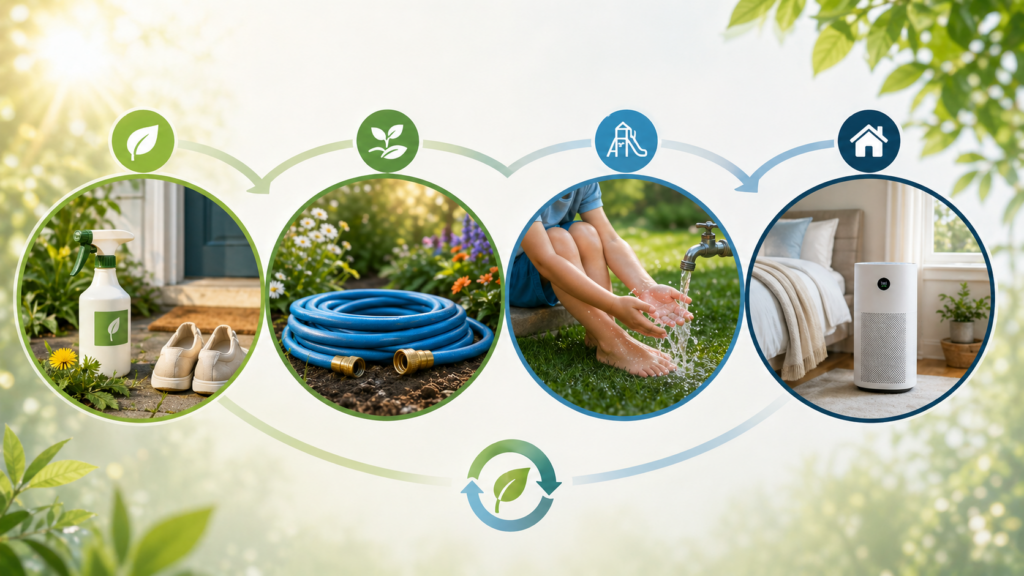
Small, consistent choices compound. That is the Vitality Cycle principle — applied to your environment.
FREE GIFT: My FREE Clean Yard & Home Swap Guide — a simple, space-by-space list of hormone-protective swaps for your yard, garden, outdoor spaces, and home. Your summer hormone protection plan, all in one place. → CLICK HERE
Ready to explore your total hormone burden with personalized support? Book your FREE 20-minute Vitality Assessment Call at ConsultLori.com.
Creating the Vitality You Crave,
Lori Finlay, NP, CNS
Award-Winning Author, Create the Vitality You Crave
References
APA 7th edition format. Citations in order of appearance.
1. Baker, J. M., Al-Nakkash, L., & Herbst-Kralovetz, M. M. (2017). Estrogen-gut microbiome axis: Physiological and clinical implications. Maturitas, 103, 45–53.
2. La Merrill, M. A., Vandenberg, L. N., Smith, M. T., et al. (2020). Consensus on the key characteristics of endocrine-disrupting chemicals as a basis for hazard identification. Nature Reviews Endocrinology, 16(1), 45–57.
3. Vandenberg, L. N., Colborn, T., Hayes, T. B., et al. (2012). Hormones and endocrine-disrupting chemicals: Low-dose effects and nonmonotonic dose responses. Endocrine Reviews, 33(3), 378–455.
4. Samsel, A., & Seneff, S. (2013). Glyphosate’s suppression of cytochrome P450 enzymes and amino acid biosynthesis by the gut microbiome: Pathways to modern diseases. Entropy, 15(4), 1416–1463.
5. Hayes, T. B., Anderson, L. L., Beasley, V. R., et al. (2011). Demasculinization and feminization of male gonads by atrazine: Consistent effects across vertebrate classes. Journal of Steroid Biochemistry and Molecular Biology, 127(1–2), 64–73.
6. Krishnaswamy, K., Orsat, V., Thangavel, K., & Singh, J. (2012). Phthalate leaching from PVC garden hoses. Journal of Environmental Science and Health, Part B, 47(3), 217–225.
7. Llorca, M., Farré, M., Tavano, M. S., & Barceló, D. (2011). Characterization of perfluoroalkyl substances in indoor dust and outdoor air near a fluorochemical manufacturing plant. Environmental Pollution, 159(5), 1573–1580.
8. Hodgson, A. T., Rudd, A. F., Beal, D., & Chandra, S. (2000). Volatile organic compound concentrations and emission rates in new manufactured and site-built houses. Indoor Air, 10(3), 178–192.


